
Tell references and your own results apart
Understand what an example demonstrates and how to assess the video generated from your photo.
· Hit the Road Dude
Start here
Understand what an example demonstrates and how to assess the video generated from your photo.
In this guide
At a glance
| Review point | What to check |
|---|---|
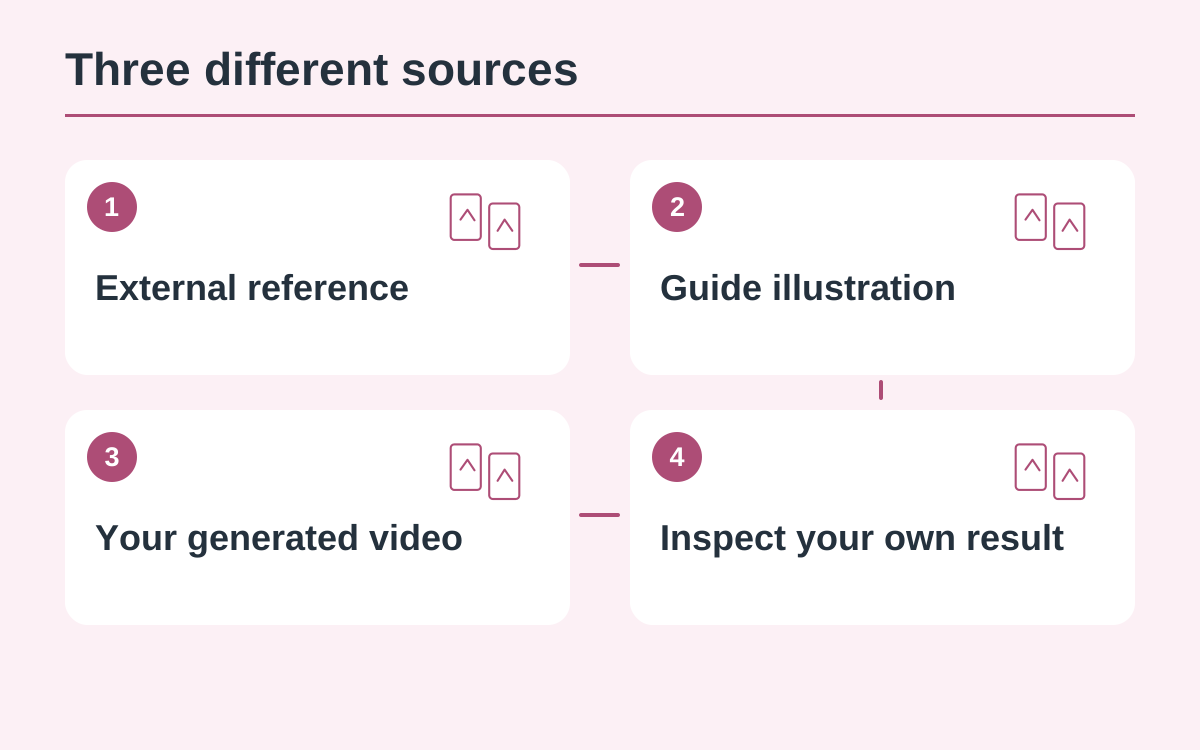
| Source label | Read attribution before using a sample to judge quality or sound; an external clip does not prove the displaying website generated it. |
| Comparable task | Compare subject type, framing and action sequence; a successful person, cat or dog example does not establish equal reliability for every combination. |
| Still versus playback | Use actual video playback to judge transitions, timing and speech; a poster or illustration cannot establish a complete gesture or stable voice. |
| Your private result | Review the completed work made from your photo across the entire clip, and base sharing on that received file’s identity, action and audio. |
| Limits of inspiration | Separate observed sample details from unknown models or editing steps; describe your output as an AI interpretation without implying affiliation or a real performance. |
Read the source label
An external reference can show the original interaction or a competing tool’s interpretation. It does not prove the displaying website generated that clip. Read attribution before using a sample to set expectations about quality or sound.
Compare the same task
People, cats and dogs can share the white-pickup environment while presenting different motion challenges. Compare subject type, framing and action sequence rather than assuming one successful example proves every combination works equally well.
Distinguish a cover from a video
A poster or editorial illustration can explain a scene without showing motion or audio. Only playing the actual clip reveals transitions, timing and speech. A beautiful still cannot establish a faithful final gesture or stable voice.
Review your own work independently
Use your private library to inspect the completed task created from your photo. Compare identity, action and audio across the full clip. A reference remains useful context, but your share decision should be based on the file you actually received.
Avoid turning inspiration into a guarantee
Record what you observed in a sample and what remains unknown, such as the model or editing steps. If you share your output, present it as your AI interpretation. Do not claim affiliation with the original creator or imply that another person actually performed it.
Questions about this guide
No. Follow the sample’s attribution. An external clip can explain a scene while providing no evidence about this site’s output.
Continue reading
Make a Hit the Road Dude videoPhoto privacy guide